

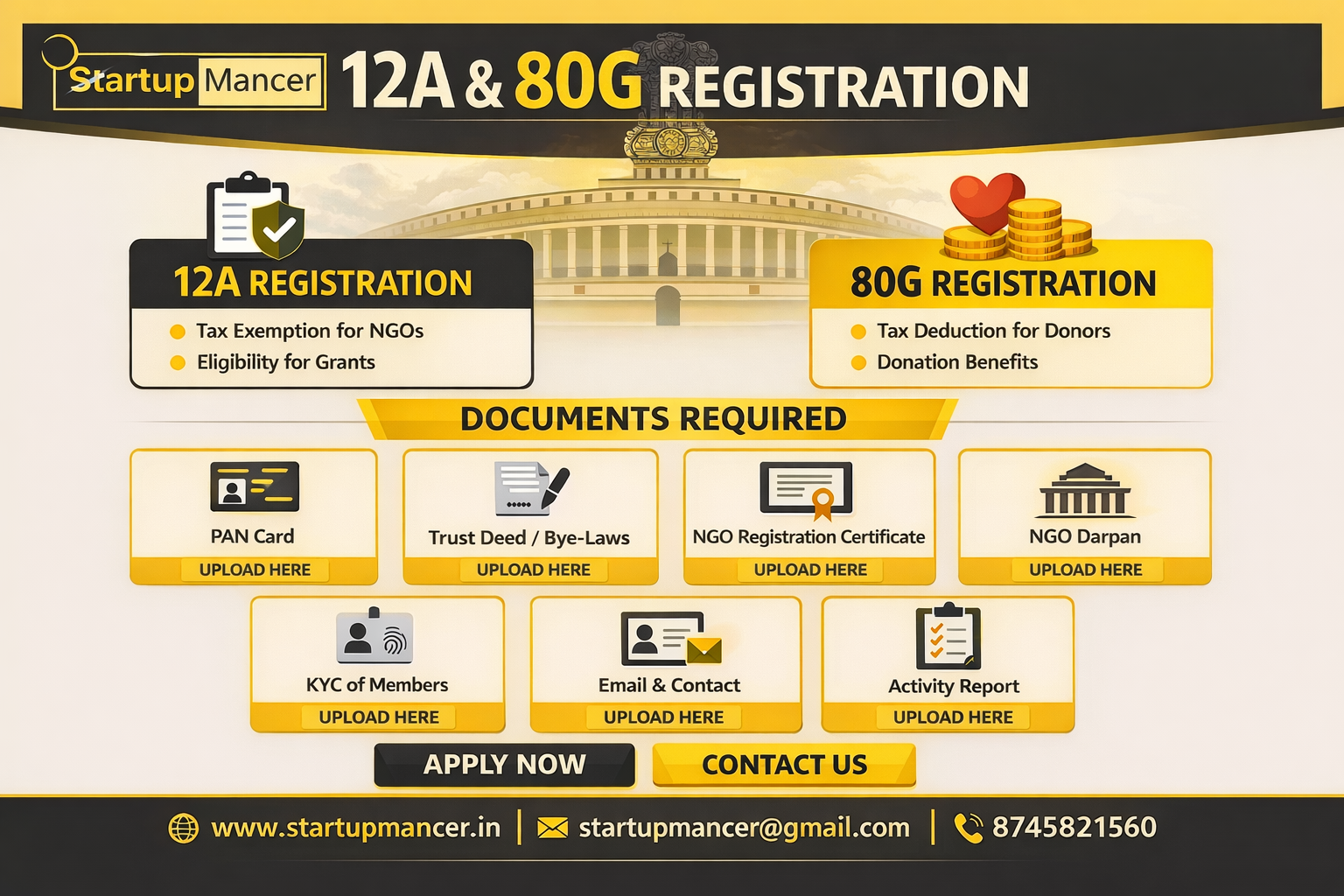
12A & 80G Registration is the backbone of any NGO. These registrations help nonprofits save income tax, attract more donors, build credibility, and ensure long-term financial sustainability.
12A Registration provides income tax exemption on an NGO’s surplus (Income minus Expenses). Without 12A, NGOs must pay income tax on surplus, reducing funds available for charitable work.
For example, if an NGO earns a surplus of ₹50,000 without 12A Registration, it may pay ₹15,000 as income tax (30%), leaving only ₹35,000 for social impact. With 12A Registration, the full surplus can be used for charitable activities.
80G Registration allows donors to claim tax deductions on donations. NGOs without 80G lose donor interest because donors receive no tax benefit. Having 80G improves fundraising, CSR eligibility, and donor confidence.
In simple terms, 12A helps NGOs save tax, and 80G helps donors save tax, strengthening the NGO’s credibility and funding capacity.
12A Registration is an approval granted by the Income Tax Department of India that allows NGOs to claim exemption on their income. Once an organization is registered under Section 12A of the Income Tax Act, it is not required to pay income tax on surplus, provided the funds are used for charitable purposes.
The main objective of 12A Registration is to ensure that genuine charitable organizations are not taxed on funds meant for public welfare. It encourages NGOs to focus on their mission by reducing their financial burden.
With 12A Registration, an NGO can retain its entire surplus instead of paying tax. This improves financial stability and allows the organization to expand its activities, reach more beneficiaries, and strengthen long-term planning.
12A Registration is available for organizations working for charitable and social purposes, including Charitable Trusts, Registered Societies and Section 8 Companies.
80G Registration is an approval granted by the Income Tax Department of India that allows donors to claim tax deductions on donations made to eligible NGOs. This registration is issued under Section 80G of the Income Tax Act and plays a key role in improving an NGO’s fundraising potential and donor credibility.
The primary purpose of 80G Registration is to promote charitable donations by offering tax benefits to donors. When donors receive tax deductions, they feel more confident and motivated to support nonprofit organizations.
Although 80G Registration directly benefits donors, it indirectly helps NGOs attract more donations. NGOs with 80G approval are seen as more credible, transparent, and government-recognized, making them more appealing to CSR donors, corporates, and institutional funders.
The registration process is governed by the Income Tax Department and follows a structured system based on the NGO’s stage of operation. An organization may receive a provisional certificate, a regular certificate, or apply for renewal, depending on its activity stage.
A common issue is that many consultants or NGOs are unclear about when to apply for provisional, regular, or renewal registration—and this confusion can lead to delays or even loss of benefits.
Provisional registration is part of the overall registration. If the NGO is new, it should first apply for a provisional certificate using Form 10A. Later, the NGO must apply for a regular certificate within 6 months of either starting activities or the provisional certificate’s expiration—whichever is later—by filing Form 10AB. If an NGO has already commenced activities, it can directly apply for regular registration with Form 10AB. Finally, renewal is required before the expiration of the regular certificate (which is valid for 5 years) and is also done using Form 10AB.
In short, understanding when to apply for provisional, regular, or renewal ensures an NGO never misses out on tax benefits.
To understand whether you need provisional, regular, or renewal registration, follow this logical flow:
Case 1: Is your NGO newly formed and has no significant charitable activity yet? If yes, you start with a provisional registration. File Form 10A. Once approved, the provisional certificate is valid for 3 years and the certificate is in form 10AC.
Case 2: If you already have a provisional certificate, when do you apply for regular? You apply for regular registration (Form 10AB) within 6 months of either starting your activities or before the provisional certificate expires—whichever is later. The regular certificate is in form 10AD
Case 3: If your NGO has already commenced charitable activities and you have proof, you can skip provisional and directly apply for regular registration using Form 10AB and the certificate is in form 10AD.
Case 4: If you already have a regular certificate, it is valid for 5 years. You must apply for renewal before it expires—specifically, at least 6 months before the expiry date, again using Form 10AB.
In short: New NGOs start with provisional. Active NGOs go straight to regular. Renew before your regular certificate expires. Following the right path ensures you maintain all tax benefits without interruption.
Provisional registration is for new NGOs that have not yet started significant activities.
Step 1: Document Collection and Validation: Gather basic documents like the NGO registration certificate, PAN, and KYC documents.
Step 2: Application of Form 10A: Submission of Form 10A online with for provisional registration. For provisional registration of 12A the section code to be selected is 02-Item (A) of sub-clause (vi) of clause (ac) of sub-section (1) of section 12A and for provisional 80G the section code is 12-Sub-clause (A) of clause (iv) of first proviso to sub-section (5) of section 80G.
Step 3: Submission via DSC or Aadhaar OTP: The form is submitted with either a Digital Signature Certificate (DSC) or Aadhaar-based OTP.
Step 4: Certificate Issuance (Form 10AC): The provisional certificate (Form 10AC) is usually issued within 7 to 10 working days which is valid for 3 years and issed on temporary basis.
Note: Provisional registration is temporary. The NGO must apply for regular registration (Form 10AB) within 6 months of starting activities or 6 months before the provisional certificate expires—whichever is later. Delaying this step increases the chance of rejection later, so timely filing is crucial.
The process for regular registration and converting from provisional to regular is the same. After activities have started, the NGO must secure a regular certificate valid for 5 years.
Step 1: Document Collection and Validation: Ensuring all required documents are ready and correct.
Step 2: Application of Form 10AB in required section code:
a) Direct Regular (for existing active NGOs): For 12A, the section code is 4A-Item (B) of sub-clause (vi) of clause (ac) of sub-section (1) of section 12A and for 80G, the section code is 14A-Sub-clause (B) of clause (iv) of first proviso to sub-section (5) of section 80G.
b) Conversion from Provisional: For 12A, the section is 02-Sub clause (iii) of clause (ac) of sub-section (1) of section 12A and for 80G, the section code is 14-Clause (iii) of first proviso to sub-section (5) of section 80G.
Step 3: Department Notice for Clarifications: The Income Tax Department may request additional documents or clarification to verify the NGO’s genuine activities.
Step 4: Reply to Notice: Promptly respond with the requested information and documents to avoid delays.
Step 5: Final Order of Approval or Rejection: Based on the review, the department will either approve (issuing Form 10AD) or reject the application. The certificate is valid for 5 years. The whole registration process takes approx. 6 months
Note: In nearly 80% of cases, rejections occur because either the NGO’s documents are not maintained properly or consultants lack experience, resulting in poor submissions and responses.
The document requirements are the same for both 12A and 80G Registration. However, additional records are required when applying for Regular Registration or converting from Provisional to Regular.
| S.No | Document Name | Provisional Registration (Form 10A) | Regular Registration / Conversion (Form 10AB) |
| 1. | Registration Certificate of the NGO | Required | Required |
| 2. | PAN Card of the NGO | Required | Required |
| 3. | Trust Deed / Bye-Laws / MOA & AOA | Required | Required |
| 4. | KYC Documents of all Members / Trustees / Directors | Required | Required |
| 5. | Email & Contact No. of all Members / Trustees / Directors | Required | Required |
| 6. | NGO Darpan Registration Certificate | Required | Required |
| 7. | Audited Financial Statements of Last 3 Years | Required | Required |
| 8. | Activity Reports of Last 3 Years | Required | Required |
| 9. | Photos of NGO Activities | Required | Required |
| 10. | Bills & Vouchers in Support of Activities | Required | Required |
| 11. | Bank Statements of Last 3 Years | Required | Required |
| 12. | Details of Beneficiaries | Required | Required |
| 13. | List of Donors | Required | Required |
Many NGOs face rejection in 12A & 80G Registration due to small but critical mistakes in documentation, category selection, or application handling. Most rejections happen not because NGOs are ineligible, but because the filing is incorrect or poorly managed.
1. Applying Under the Wrong Category (Provisional vs Regular): Choosing the wrong category is a common mistake. New NGOs should apply for provisional registration, while active NGOs with past records should apply for regular registration. Incorrect selection often leads to rejection or delays.
2. Poor or Incomplete Documentation: Missing documents, unclear Trust Deed objectives, mismatched PAN or address details, and incomplete records are major reasons for rejection. Proper and accurate documentation is essential for approval.
3. Weak or No Activity Proof: For regular registration, NGOs must show genuine charitable work. Applications are rejected when activity reports, photos, beneficiary details, or program evidence are weak or missing
4. Improper Financial Records: Unclear or poorly maintained financial statements, bank records, and donation details raise doubts during scrutiny and can result in rejection.
5. Delayed or Incorrect Reply to Income Tax Notices: Late, incomplete, or incorrect responses to Income Tax notices increase the risk of rejection, as they create concerns about compliance and transparency.
6. Delay in Conversion from Provisional to Regular: NGOs that fail to convert provisional registration to regular within the required timeline face higher scrutiny and increased chances of rejection.
7. Inexperienced or Careless Consultant Handling: Nearly 80% of rejections occur due to consultant mistakes such as incorrect form selection, careless drafting, poor documentation, or weak notice replies.
Conclusion on Avoiding Common Mistakes: Most rejections can be avoided with correct category selection, proper documentation, transparent records, timely responses, and experienced handling of the application.
12A & 80G Registration is not just a compliance requirement, it is a foundation for NGO growth. It helps NGOs save tax, build donor trust, and create long-term financial sustainability. Without these registrations, NGOs lose valuable funds to taxation and face difficulties in fundraising.
Choosing the right registration path, maintaining proper documents, and following the correct process ensures smooth approval and long-term benefits. With the right guidance and professional handling, NGOs can secure 12A & 80G Registration successfully and focus on what truly matters — creating real social impact.